The Vibe Father

Short answer, use Claude Opus 5 unless you are doing health-adjacent work. Opus 5 posts a higher published Intelligence Index than Fable 5 — 61 to 60 — and costs exactly half as much, $5/$25 per million tokens against Fable 5's $10/$50.
That is an unusual thing for a vendor to do to its own flagship six weeks after shipping it, and it is why "opus 5 vs fable 5" went vertical in US searches within hours of the launch. This page answers the comparison properly, what each model wins, what the published evidence actually supports, and the two cases where staying on Fable 5 is still defensible.
Related every Opus 5 benchmark explained, the full vs-every-model hub, and the live Opus 5 vs Fable 5 scorecard.
The pricing gap, first
| Model | Input per 1M | Output per 1M | Context |
|---|---|---|---|
| Claude Opus 5 | $5 | $25 | 1M tokens |
| Claude Fable 5 | $10 | $50 | 1M tokens |
Same context window, exactly double the price. Before any capability discussion, that means a Fable 5 workload moved to Opus 5 halves its token bill with no other change. If the capability were merely equal, that alone would settle it.
It is not merely equal. On the measured boards, Opus 5 is ahead.

Head to head on published evidence
| Measure | Opus 5 | Fable 5 | Winner |
|---|---|---|---|
| Intelligence Index | 61 | 60 | Opus 5 |
| Frontier-Bench v0.1 | 43.3% | 33.7% | Opus 5 |
| GDPval-AA v2 | 1,861 Elo | 1,747 Elo | Opus 5 |
| AA-Briefcase | 1,720 Elo | ~1,574 Elo | Opus 5 by 146 |
| CursorBench 3.2 | Within 0.5% of peak | Peak score | Effectively tied |
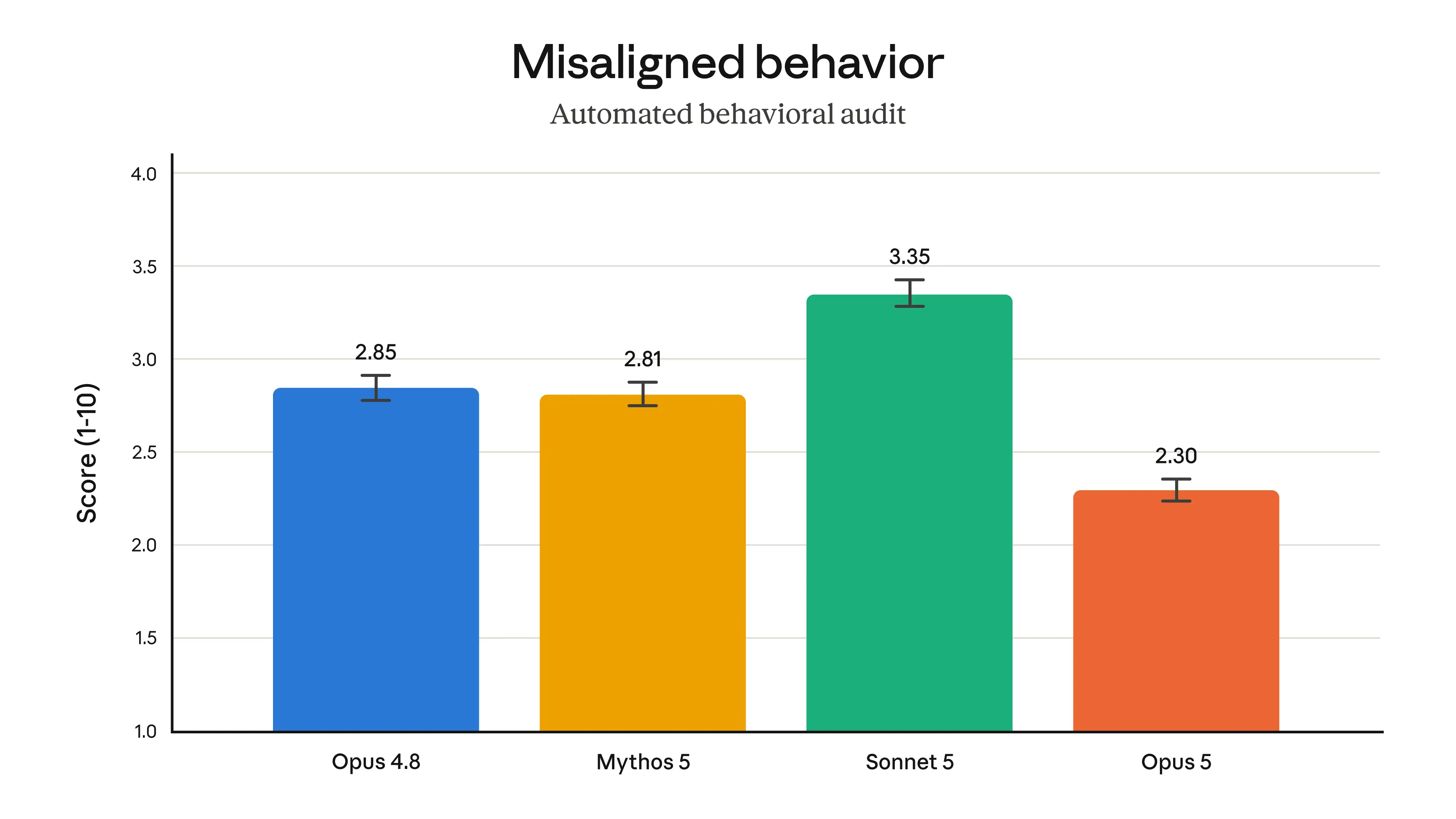
| Alignment audit | Most aligned tested | Behind Opus 5 | Opus 5 |
| Health tasks | Behind | Leads | Fable 5 |
| Price per 1M | $5 / $25 | $10 / $50 | Opus 5 |
One important honesty note that most comparison posts skip. Fable 5's Coding and Agentic index values are not separately published. Artificial Analysis lists Opus 5 at Coding 78 and Agentic 55, but there is no third-party Fable 5 number on those two boards to compare against. So when you see "Opus 5 beats Fable 5 at coding," that claim rests on vendor comparisons, not an independent board.
The Intelligence Index comparison is solid. The price comparison is solid. The coding-specific comparison is directional, not proven. We would rather tell you that than pad the table.
The CursorBench detail worth understanding
Anthropic's own framing is that Opus 5 lands within 0.5% of Fable 5's peak CursorBench 3.2 score at half the cost. Read that carefully, it is a claim of parity at half price, not superiority, on that particular benchmark.
That is still an excellent result — matching a model that costs twice as much is the whole value proposition — but it means the honest summary of Opus 5 vs Fable 5 is "equal-to-better capability at half price," not "a generational leap over Fable 5." The generational leap is against Opus 4.8, where Frontier-Bench goes from 18.7% to 43.3%.
When Fable 5 is still the right call
| Situation | Stay on Fable 5? | Why |
|---|---|---|
| Health and clinical-adjacent work | Yes | Fable 5 is reported to lead on health tasks |
| You have a validated Fable 5 eval suite | Temporarily | Re-run it before switching — do not switch blind |
| Contractual model pinning | Yes, until renewal | Compliance beats a price cut |
| General coding and agent work | No | Opus 5 is equal-or-better at half the price |
| Long-horizon research agents | No | Frontier-Bench gap is large |
| Cost-sensitive high volume | No — but consider Sonnet 5 | Neither Opus tier may be the right lane |
The middle row is the one people under-weight. If you have spent months tuning prompts and evals against Fable 5, the switching cost is not zero even when the model is strictly better and cheaper. Run your suite, confirm, then move. A week of validation is cheap insurance against a quarter of subtle regressions.
What about Mythos 5?
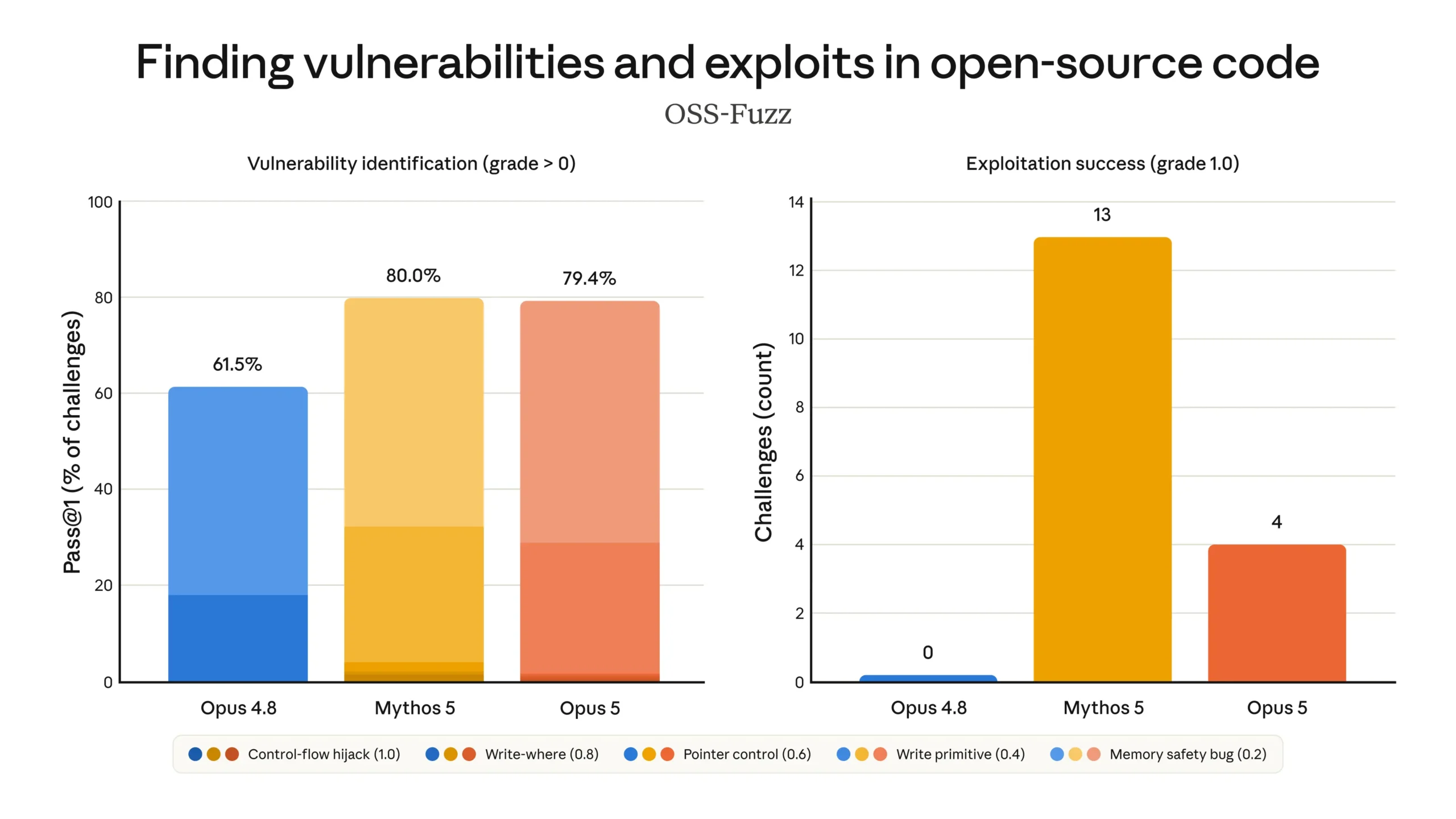
Worth clearing up, because it confuses the Anthropic lineup. Mythos 5 uses the same underlying model as Fable 5 with different safeguards and access conditions. It is reported to lead on legal tasks and on exploit development — the latter being an area where Opus 5 is deliberately weaker.
For most engineering teams Mythos 5 is not part of this decision at all, it is a trusted-access product rather than a general default. If your work is legal analysis or offensive security research, it is the one to look at. Otherwise, the real comparison is Opus 5 against Fable 5 against Sonnet 5.
The three-model Anthropic decision
| Model | Price per 1M | Use it for |
|---|---|---|
| Claude Opus 5 | $5 / $25 | Hard debugging, long-horizon agents, planning |
| Claude Fable 5 | $10 / $50 | Health-adjacent work, otherwise being retired by price |
| Claude Sonnet 5 | $2 / $10 introductory, then $3 / $15 | Routine features, mechanical edits, interactive surfaces |
Sonnet 5's introductory rate runs through August 31, 2026. One trap when you model the saving. Sonnet 5 uses a newer tokenizer that counts roughly 30% more tokens for the same text, so per-token parity is not per-request parity. Measure on your own prompts.
The architecture that beats picking any single winner is escalation. Send each task to the cheapest model that reliably completes it, and escalate to Opus 5 on failure. Teams that do this routinely spend less than teams on a cheap model alone, because the cheap-model-only teams pay for retries and human repair instead.
Where the coding comparison actually stands
Because this is the question most people are really asking, it deserves more than the caveat above. Here is the complete public picture for coding specifically.
| Evidence | Opus 5 | Fable 5 | Status |
|---|---|---|---|
| Artificial Analysis Coding Index | 78 | Not published | No comparison possible |
| Frontier-Bench v0.1 (agentic coding) | 43.3% | 33.7% | Reported, both models |
| CursorBench 3.2 | Within 0.5% of peak | Peak | Vendor framing — parity |
| SWE-bench Verified | 96.0% | Not directly compared | Tracker figure |
| Arena Code WebDev | Votes accumulating | Existing votes | Pending for Opus 5 |
So, on the one agentic-coding benchmark where both models have a reported number, Opus 5 leads by about ten points. On the interactive editor benchmark, they are effectively tied. On the independent coding board, only one of them has a score.
"Better at agentic coding, level on editor work, unproven on the independent board, half the price" is the accurate sentence. It is less punchy than "Opus 5 destroys Fable 5" and it is what the evidence supports.
Arena Code WebDev is the one to watch over the next fortnight. It measures human preference on real web-development outputs, and it has a track record of disagreeing with static benchmarks. Once Opus 5 accumulates votes, our coding dimension blends that signal at a fixed weight — which means the number on the live comparison may move even though nothing about either model changed.
Migrating from Fable 5 to Opus 5
- Swap the model ID to
claude-opus-5in a branch, not in production. - Set effort deliberately. Opus 5 exposes low, medium, high, xhigh and max. High is the sane production default, the launch benchmarks were run at max.
- Re-run your eval suite. Twenty real tickets, scored on accepted diff, repair rate, and token cost.
- Watch latency. Reasoning-first models are slow to first token. If a human waits on the output, drop the effort or use fast mode.
- Compare cost per accepted change, not price per token. That is the number that decides whether the halved rate actually reached your bill.
- Pin the revision once you switch, so behaviour does not drift mid-sprint.
Expect the token bill to fall by more than half in most cases, because the price halves and a stronger model typically needs fewer retries. Expect wall-clock per task to rise if you leave effort high. Those two move in opposite directions, which is exactly why cost per accepted change is the metric that matters.
What Fable 5 was for, and why this feels abrupt
Fable 5 arrived alongside Mythos 5 as Anthropic's frontier pair, priced at $10/$50 — the tier that says "this is the best we have, and it is expensive because it is." Six weeks later a cheaper model matches or beats it on the published boards. It is reasonable to feel that the ground moved.
The useful interpretation is not that Fable 5 was oversold. It is that frontier pricing reflects what a capability costs to serve at the time it ships, and that number falls fast. Opus 5 is a newer architecture priced at parity with Opus 4.8 rather than at Fable 5's tier, which is a decision about positioning as much as cost.
| Model | Shipped | Launch price per 1M |
|---|---|---|
| Claude Opus 4.8 | May 2026 | $5 / $25 |
| Claude Fable 5 / Mythos 5 | June 2026 | $10 / $50 |
| Claude Sonnet 5 | June 30, 2026 | $2 / $10 introductory |
| Claude Opus 5 | July 24, 2026 | $5 / $25 |
Four releases in three months, and the price of frontier capability roughly halved across that window. If your procurement cycle assumes a model choice holds for a year, that assumption is now the problem — not any individual model.
The knowledge-work gap is bigger than the coding gap
Most coverage frames this matchup around code. The larger measured separation is actually on professional knowledge work.
| Benchmark | Opus 5 | Fable 5 | Gap |
|---|---|---|---|
| GDPval-AA v2 | 1,861 Elo | 1,747 Elo | 114 Elo |
| AA-Briefcase | 1,720 Elo | — | 146 Elo lead |
| Intelligence Index | 61 | 60 | 1 point |
GDPval-AA v2 measures real professional knowledge work through an open-source reference agent harness. A 114-Elo gap there is a much larger separation than a one-point index difference, and it maps onto the work engineering teams actually spend most of their time on, reading tickets, reconciling requirements, drafting migration plans, and writing the document that explains why a change is safe.
If your Fable 5 usage is mostly planning, spec-writing and analysis rather than code generation, that is the number that should move you — and it moves in the same direction as the price.
If you use the Claude apps rather than the API
The pricing comparison above is API list pricing. On the consumer and team plans the calculation is different. Opus 5 is the default on Claude Max and the most capable model available on Claude Pro, so for many seat holders the switch is a picker change rather than a billing decision.
The thing to check on a plan rather than an API key is usage limits. A model that reasons more per turn consumes more of whatever budget your plan meters, so "free to switch" at the seat level does not always mean "free to use the same way." Watch your first week before you change team defaults.
Reading the search spike honestly
"Opus 5 vs Fable 5" and its variants rose between 250% and 1,350% in US searches in the 24 hours after launch, alongside "claude opus 5 pricing" and "opus 5 artificial analysis." That pattern — comparison plus pricing plus independent-benchmark queries — is what a credible launch looks like. People are not asking whether it is real, they are asking what it costs and who verified it.
It is also a reminder that most of the traffic around a model launch is decision traffic, not curiosity traffic. The people searching this term have a Fable 5 bill in front of them. The useful answer is a number and a migration path, not adjectives.
Common questions
Is Opus 5 better than Fable 5?
On the published Intelligence Index, yes — 61 to 60 — and it leads Frontier-Bench, GDPval-AA v2 and AA-Briefcase, at half the price. Fable 5 is reported to still lead on health tasks.
Is Opus 5 cheaper than Fable 5?
Exactly half, $5/$25 per million tokens against $10/$50, with the same 1M context window.
Why is Fable 5 more expensive if it scores lower?
It launched earlier at frontier pricing. Opus 5 is the newer architecture, and Anthropic priced it at parity with Opus 4.8 rather than at Fable 5's tier.
Should I switch today?
Switch after you re-run your evals, not before. The model is better and cheaper, your prompts were still tuned against something else.
What about coding specifically?
Opus 5 posts a Coding Index of 78. Fable 5 has no published Coding Index, so treat coding-specific superiority claims as directional rather than measured. On Frontier-Bench v0.1, where both have reported numbers, Opus 5 leads 43.3% to 33.7%.
Does Opus 5 replace Fable 5 entirely?
Not formally — Fable 5 remains available, and it is reported to lead on health tasks. But for general engineering work, a model that scores higher and costs half as much makes the older tier hard to justify.
Sources and further reading
- Anthropic. Introducing Claude Opus 5
- Artificial Analysis. Claude Opus 5
- The Decoder, half the token price
- Live Opus 5 vs Fable 5 comparison
- What the Opus 5 system card says
If you only take one thing from this page, the interesting number is not 61 versus 60. It is that a frontier lab cut the price of frontier capability in half within six weeks of its previous flagship, and did it while the independent boards agreed the newer model was better. Whatever that does to your model choice, it should also change how far ahead you are willing to plan a budget. Six weeks is the new planning horizon, and pretending otherwise is how teams end up locked into last quarter's pricing.