The Vibe Father

July 2026 produced a frontier proprietary launch, the largest open-weight model ever published, and a wave of capable open competitors — inside four weeks. If you are trying to work out what changed and whether any of it should touch your stack, this is the working roundup.
The short version, one release changes the default for most coding teams, one changes the open-weight landscape, and the rest are worth knowing about without being worth a migration.
The month at a glance
| Model | Date | Weights | Price per 1M | Matters because |
|---|---|---|---|---|
| Claude Opus 5 | Jul 24 | Closed | $5 / $25 | Top published index scores at half Fable 5's price |
| Kimi K3 | Jul 16 (weights Jul 27) | Open, Modified MIT | $3 / $15 | Largest open-weight model published, frontier-adjacent coding |
| GLM-5.2 | Current | Open, MIT | — | 1M context, GPQA Diamond reported at 91.2% |
| DeepSeek V4 Pro | Current | Open, MIT | — | Code and maths focus under a permissive license |
| MiniMax-M3 | Current | Open | — | SWE-bench Pro reported at 59.0%, 1M context, multimodal |
Claude Opus 5 — the one that changes defaults
Shipped July 24 at $5 in and $25 out per million tokens, with a 1M context window and five effort levels. It takes the top published position on the Artificial Analysis Intelligence Index (61) and Agentic Index (55), and ties for first on the Coding Index (78).
The reason it matters is not the index positions, which are narrow — one point over Fable 5 on Intelligence, a tie with GPT-5.6 Sol on Coding. It is that Anthropic priced it at parity with Opus 4.8 and at half of Fable 5. Equal-or-better capability at half the price makes the previous frontier tier hard to justify for general engineering work.
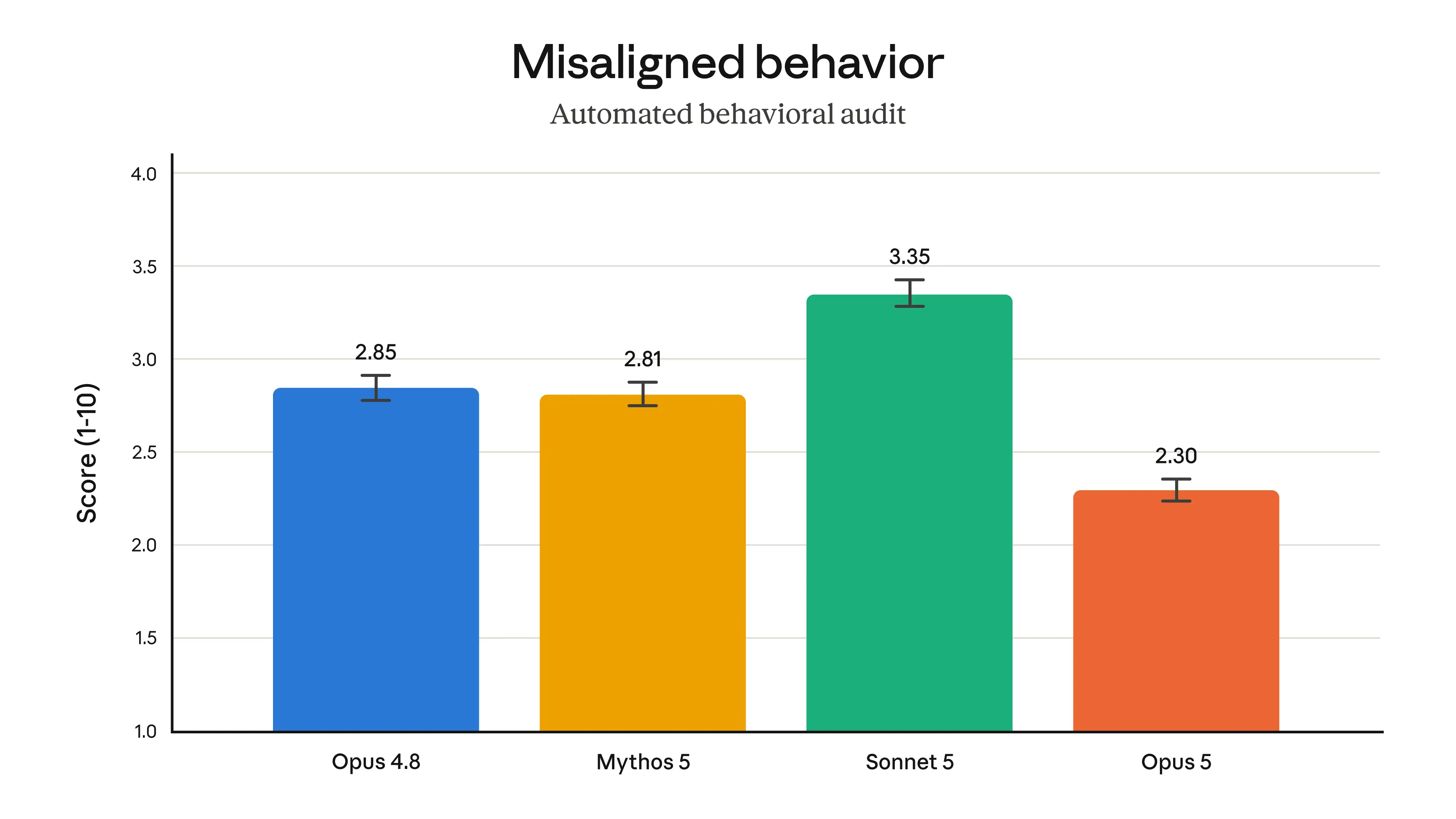
It also loses things, which is worth knowing. GPT-5.6 Sol still wins DeepSWE v1.1 at 72.7% to 68.8%, Mythos 5 leads on legal and exploit development, and Fable 5 is reported to lead on health tasks. Full detail in every Opus 5 benchmark explained.
There is also a quieter enterprise consequence. Opus 5 is eligible for Zero Data Retention, while Fable 5 and Mythos 5 are Covered Models requiring 30-day retention. For regulated teams that turns a preference into a constraint — see the retention guide.
Kimi K3 — the one that changes the open landscape
Unveiled July 16 at the World AI Conference in Shanghai and available through Moonshot's API since, with full weights publishing July 27 under a Modified MIT license. It is a 2.8-trillion-parameter multimodal mixture-of-experts model with a 1M token context window — the largest open-weight model released to date.
On public measures it leads open-weight coding, roughly 81.45 on LiveBench Coding Average and 57.58 on Agentic Coding Average. On our own board it sits at a Vibe Coding Index of 64.1 from a tentative multi-source profile.
The catch is scale. In four-bit precision the weights need about 1.4TB of fast memory — roughly eighteen H100-class GPUs before any context loads. "Open weights" here does not mean "you can run it." See what you can actually run.
The open-weight field behind it
| Model | License | Notable | Realistic to self-host? |
|---|---|---|---|
| Kimi K3 | Modified MIT | 2.8T params, 1M context, vision | No — data-centre scale |
| GLM-5.2 | MIT | 1M context, GPQA Diamond 91.2% reported | Depends on deployment |
| DeepSeek V4 Pro | MIT | Code and maths focus | Depends on deployment |
| MiniMax-M3 | Open | SWE-bench Pro 59.0% reported, multimodal | Depends on deployment |
A genuine MIT license on a capable model is worth more than a point or two of benchmark score for anyone with procurement constraints. GLM-5.2 and DeepSeek V4 Pro being MIT rather than a custom license removes a legal review step that can otherwise take longer than the integration.
Treat the reported figures here as reported. They come from launch materials and aggregators rather than a single harness applied uniformly, which is exactly the mixing problem covered in how to read leaderboards.
What the cadence means
| Month | Notable releases |
|---|---|
| May 2026 | Claude Opus 4.8 |
| June 2026 | Claude Fable 5, Mythos 5, Sonnet 5 |
| July 2026 | Kimi K3, Claude Opus 5, plus the open field |
Three months, and frontier capability roughly halved in price while open-weight models reached the frontier conversation. That cadence has a practical consequence most teams have not adjusted to a model choice is now a six-week decision, not an annual one.
The response is not to chase every release. It is to make switching cheap. If your stack routes through a gateway, pins model revisions, and has a frozen evaluation suite, a new model is an afternoon of measurement. If it hard-codes a model ID in forty places, every launch is a project.
The open-weight geography
One structural detail worth noticing, the open-weight releases this month came predominantly from Chinese labs — Moonshot's Kimi K3, Zhipu's GLM-5.2, DeepSeek V4 Pro, MiniMax-M3 — while the frontier proprietary launch came from a US lab.
| Release type | July 2026 pattern |
|---|---|
| Frontier proprietary | Claude Opus 5 |
| Frontier open weights | Kimi K3 |
| Capable permissive open | GLM-5.2, DeepSeek V4 Pro, MiniMax-M3 |
Whatever the strategic reading, the practical consequence for engineering teams is straightforward, the open-weight options worth evaluating are increasingly not from the vendors you already have contracts with. That means procurement, licence review and provider routing become part of the evaluation rather than afterthoughts, and it is worth finding out now whether your organisation has a policy on this before a model you want to use runs into one.
Which of these should touch your stack
- On Opus 4.8 evaluate Opus 5. Same price, materially better. This is the clearest action on the list.
- On Fable 5 evaluate Opus 5 unless you do health-adjacent work. You are likely paying double.
- On GPT-5.6 Sol stay unless your work is not repo-scale. Sol still wins DeepSWE.
- Cost-constrained look at Kimi K3 via a provider at $3/$15, and at Sonnet 5.
- Regulated check the ZDR distinction before anything else.
- Wanting open weights route to them hosted, watch for K3 distillations rather than planning to self-host.
- On a permissive-licence requirement look at GLM-5.2 and DeepSeek V4 Pro under plain MIT before the Modified MIT of K3.
- Running long agent tasks the MCP Tasks extension and framework durable execution matter more to you this month than any model on this list.
Running a monthly model review
Given the cadence, the useful process change is not reading more launch coverage. It is a short, scheduled review that turns launches into a decision or a shrug.
| Step | Time | Output |
|---|---|---|
| Scan what shipped | 15 min | A list, filtered to your lanes |
| Check price and licence changes | 10 min | Any change to unit economics |
| Decide if anything warrants testing | 5 min | Usually nothing, sometimes one |
| Run the frozen ticket suite if it does | An afternoon | Accepted rate, cost per change, repair rate |
| Report one sentence | 2 min | "Default stays" or "default moves" |
Thirty minutes most months, an afternoon occasionally. The alternative — re-litigating model choice in a channel every time a launch trends — costs more attention and produces worse decisions, because it is driven by whoever read the most enthusiastic thread.
The prerequisite is the frozen ticket suite. Without it, step four is impossible and every launch collapses back into opinion.
What did not happen this month
Worth stating, because absence is information too.
- No frontier price increase. Every move this quarter was flat or downward.
- No model regression. Nothing shipped and was withdrawn for capability problems.
- No closing of the open-weight gap. If anything it narrowed further.
- No consolidation of benchmarks. The field fragmented further, which is why methodology literacy keeps mattering.
- No change to the fundamentals. Context discipline, verifiable definitions of done and cost per accepted change still determine outcomes more than model choice.
That last point is the one to hold onto during a month like this. Five model launches did not change the fact that the highest-leverage improvements available to most teams are caching their context, capping their retries, and writing clearer definitions of done.
The pattern worth noticing
Two things happened simultaneously this month that are usually discussed separately.
Proprietary frontier capability got dramatically cheaper — Opus 5 at half of Fable 5's price, six weeks later. And open-weight models reached genuine frontier adjacency, with K3 leading open coding boards.
Those are related. Competitive pressure from capable open weights is one of the forces that makes a lab price its new flagship at parity with its old one instead of at a premium. You do not have to run an open model to benefit from its existence, the benefit arrives as a lower invoice from the vendor you already use.
The counterweight is that frontier open weights have become unrunnable for almost everyone. The democratising layer has moved down to distilled derivatives, and that is where a team with a single GPU should be looking.
A note on reading launch months like this
Five significant releases in four weeks produces a strong pull toward action, and the pull is mostly wrong. Nothing on this list obliges you to change anything today.
The two genuinely actionable items are narrow, if you are paying Fable 5 prices for general engineering work you are probably overpaying, and if you are on a Zero Data Retention arrangement the Covered Model distinction may already be constraining which models you are allowed to call. Everything else is context.
Read the month, note the two or three facts that touch your situation, and get back to work. The cadence will produce another list like this in about six weeks.
Common questions
What is the best new AI model for coding in July 2026?
Claude Opus 5 for most teams — top published Coding and Agentic index positions at $5/$25. GPT-5.6 Sol remains stronger on DeepSWE v1.1 for repo-scale work.
What is the best open-source coding model right now?
Kimi K3 by public measures, with weights publishing July 27 under a Modified MIT license. GLM-5.2 and DeepSeek V4 Pro are more practical if you actually intend to self-host.
Is Kimi K3 really open source?
It is open-weight, not open-source in the OSI sense — the weights are published, the training data and pipeline are not.
Should I switch models every time one launches?
No. Make switching cheap — a gateway, pinned revisions, a frozen evaluation suite — then switch only when your own measurements justify it.
Why did Opus 5 launch cheaper than Fable 5?
Anthropic priced it at parity with Opus 4.8 rather than at the frontier tier. Competitive pressure from capable open-weight models is a plausible part of that decision.
Which July release actually changes a coding stack?
Claude Opus 5 for teams on Opus 4.8 or Fable 5, because the price-to-capability move is unambiguous. Kimi K3 changes the open-weight landscape but changes very few stacks directly, since almost nobody can self-host it.
How do I keep up without reading every launch?
Run a thirty-minute monthly review against a frozen ticket suite. Scan what shipped, check price and licence changes, and only run the suite when something plausibly moves your unit economics. Most months the answer is that nothing does.
Are the open-weight benchmark figures reliable?
Treat them as reported rather than measured. They come from launch materials and aggregators rather than one harness applied uniformly across models, which is exactly the mixing problem that makes cross-source comparison unreliable.
Is there a reason to care about open weights if I will never self-host?
Yes. A capable open model puts downward pressure on hosted pricing, guarantees the weights cannot be withdrawn or deprecated under you, and lets multiple providers serve the same model so a single vendor outage is not a single point of failure. You get most of that without downloading anything.
Sources and further reading
- Anthropic. Introducing Claude Opus 5
- Artificial Analysis. Kimi K3
- LLM Stats, model release news
- The live Vibe Coding Index
- Opus 5 against every major model
If you read one thing into this month, make it the cadence rather than any individual model. The interesting question stopped being "which model is best" some time ago, because the answer changes before you finish evaluating it. The durable question is how quickly your organisation can find out — and a team that can answer "should we switch?" in an afternoon will compound an advantage over one that treats every launch as a quarter's work, regardless of which model either of them happens to be running today. Build the frozen ticket suite, put the model choice behind a gateway, pin your revisions, and the next five launches become a series of thirty-minute reviews instead of five separate arguments.