The Vibe Father
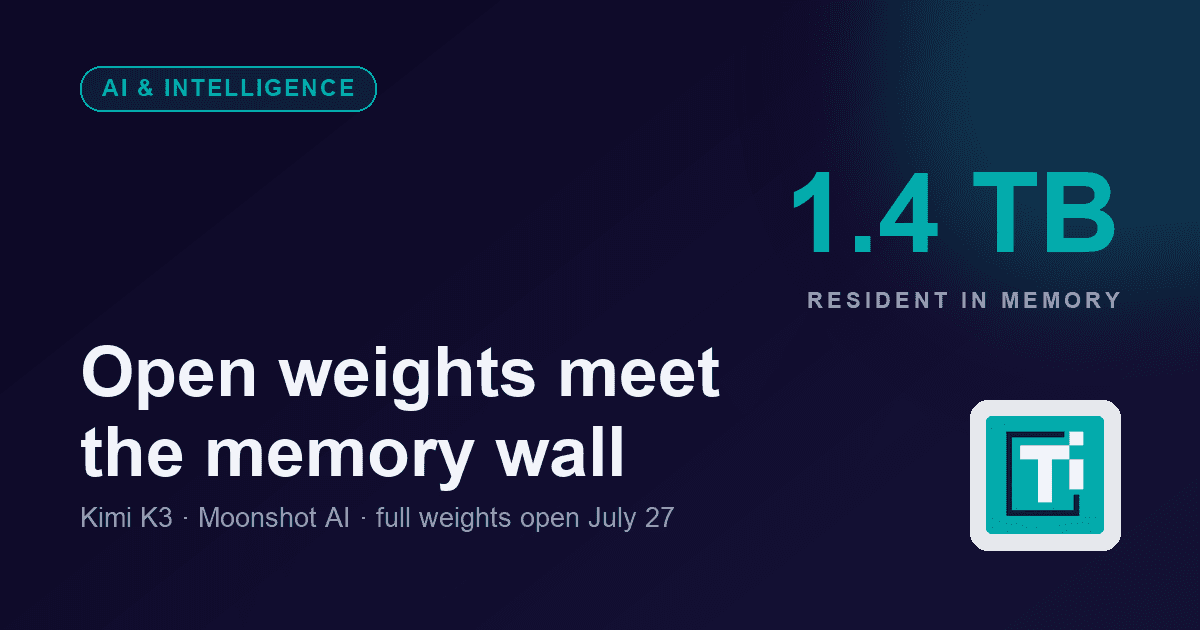
On July 27, 2026 Moonshot publishes the full Kimi K3 weights on Hugging Face under a Modified MIT license — and in four-bit precision they still require roughly 1.4 terabytes of fast memory before you load a single token of context.
That number is the whole story. "Open weights" has come to imply "you can run it," and at 2.8 trillion parameters that implication quietly stopped being true. This is an honest look at what the release actually gives you, who can use it, and why it still matters even if you will never self-host it.
Related self-hosting versus API economics and open weights as vendor-thrash insurance.
The memory wall
| Precision | Memory for weights | H100s (80GB) needed |
|---|---|---|
| MXFP4 (4-bit) | ~1.4 TB | ~18, before context |
| 16-bit | ~5.6 TB | ~70, before context |
Those figures are for weights alone. A 1M token context window needs substantial additional memory for the KV cache, and serving more than one concurrent request multiplies it.
Put in rental terms, at typical on-demand H100 pricing of roughly $2.50 per GPU-hour, eighteen GPUs is about $45 an hour, or north of $30,000 a month for a single always-on four-bit deployment — before networking, storage, redundancy, or anyone to operate it. The 16-bit configuration is several times that.
Against that, Kimi K3 through a hosted API lists at $3 in and $15 out per million tokens. You would need to be pushing enormous, sustained volume before self-hosting wins on cost, and the crossover is far past where most engineering organisations sit.
Open weights is not open source
The license is a Modified MIT — permissive, and worth reading carefully. But the more important distinction is what is being released.
| Released | Not released |
|---|---|
| Trained model weights | Training data |
| Enough to run and fine-tune | Full training pipeline |
| Enough to inspect behaviour | Enough to reproduce the model |
This is open-weight, not open-source in the OSI sense. You can download it, inspect it, fine-tune it and deploy it. You cannot rebuild it, audit what went into it, or verify claims about its training corpus.
That distinction matters most for the people who care most about open models. If your reason for wanting open weights is control and continuity, this delivers. If your reason is auditability of training data — a growing concern in regulated sectors — it does not, and no permissive license changes that.
So who is this actually for?
Four groups, and most readers are in the fourth.
| Who | What they get |
|---|---|
| Inference providers | A frontier-class model to serve — expect hosted K3 endpoints to multiply |
| Sovereign and air-gapped deployments | Frontier capability with no external API call, at enormous hardware cost |
| Research and fine-tuning labs | A 2.8T open MoE to study, distil and specialise |
| Everyone else | Price competition and an exit option they will never exercise |
That last row is the honest one, and it is not a criticism. The value of an open frontier model to a normal engineering team is almost entirely indirect, it puts downward pressure on hosted pricing, it guarantees the model cannot be withdrawn from under you, and it means multiple providers can serve the same weights so a single vendor outage is not a single point of failure.
You get most of that benefit without ever downloading 1.4TB.
Where K3 actually stands on capability
The hardware discussion should not obscure that this is a genuinely strong model. K3 is reported as the top open-weight model on LiveBench's coding averages — around 81.45 on Coding and 57.58 on Agentic Coding — with a 1M token context window and native vision.
On our own board it entered at a Vibe Coding Index of 64.1 from a tentative multi-source profile. For an open-weight model to be in the same conversation as proprietary frontier systems at all is the actual news, two years ago the gap was measured in generations rather than points.
One caveat worth carrying, at least one report flags undisclosed hallucination risk, and the training data is not published. Treat launch-period capability claims for any model — open or closed — as directional until independent reproductions land.
What a Modified MIT license actually permits
Licensing on open-weight models has become a genuine procurement issue, and "Modified MIT" is a phrase that should prompt a read rather than a nod.
| Question | Why it matters |
|---|---|
| What are the modifications? | Plain MIT is trivially approvable, modifications may not be |
| Is commercial use unrestricted? | Some model licenses cap users or revenue |
| Are outputs unencumbered? | Some restrict training other models on outputs |
| Is attribution required? | Affects product surfaces and documentation |
| Are there use-case restrictions? | Acceptable-use clauses are common in model licenses |
By contrast, GLM-5.2 and DeepSeek V4 Pro are reported under plain MIT, which for most legal teams is a five-minute review rather than an escalation. If your organisation's constraint is procurement rather than capability, an unmodified permissive license on a slightly weaker model can be worth more than a stronger model behind a bespoke one.
Read the actual license text when it publishes on July 27 rather than the summary — including this one.
How to evaluate K3 without downloading anything
You can assess this model properly today, and self-hosting is not part of it.
- Route to it through a provider. Same weights, no capital, available since July 16.
- Run your own twenty tickets against it and your current default, same harness.
- Score accepted diffs, cost per accepted change, and repair rate — not vibes.
- Test the long context honestly. A 1M window is a claim, measure retrieval quality at length rather than assuming it.
- Probe for hallucination on questions where you know the answer, given the reported concerns and undisclosed training data.
- Check latency and throughput at your concurrency, not in a single-request demo.
If it wins on cost per accepted change at $3/$15 against a frontier model at $5/$25, that is a real result worth acting on — and you will have learned it without provisioning a single GPU.
How it compares to the runnable open field
If your interest is an open model you might actually deploy rather than admire, K3 is the wrong end of the range to be looking at.
| Model | Licence | Practical to self-host? |
|---|---|---|
| Kimi K3 | Modified MIT | No — roughly eighteen H100s in four-bit |
| GLM-5.2 | MIT | Plausible with real infrastructure |
| DeepSeek V4 Pro | MIT | Plausible with real infrastructure |
| MiniMax-M3 | Open | Plausible with real infrastructure |
| Distilled K3 derivatives | Follows base licence | Likely, once they appear |
An unmodified MIT licence on a model you can serve on hardware you own is worth more, operationally, than a stronger model you can only reach through somebody else's API. Weigh licence and runnability alongside capability rather than after it.
The distillation angle
The most likely practical consequence of this release is not people running K3. It is people running things made from K3.
A 2.8T open model is raw material. Expect distilled variants, domain-specialised fine-tunes, and much smaller models trained against K3 outputs to appear over the following weeks. Historically that is where open-weight releases deliver value to ordinary teams, not the flagship, but the 30B derivative that runs on hardware you own and handles 80% of your mechanical work.
If you want to benefit from this release, the useful thing to watch is not the July 27 upload. It is what appears on Hugging Face in the four weeks after it.
What to actually do about it
- Do not plan to self-host it. Unless you already operate multi-hundred-GPU clusters, the economics are not close.
- Do route to it through a provider if you want to evaluate it — the same weights, none of the capital.
- Do keep an open-weight route configured in your gateway as insurance, even if it is not your default.
- Do watch for distilled derivatives over the next month, that is where runnable value appears.
- Do not treat "open weights" as an audit story. Training data is not published.
- Do re-run your own evaluation before switching anything. Leaderboard position is not your codebase.
The honest summary of open weights in 2026
The open-weight movement has succeeded on capability and quietly failed on accessibility. Models are now genuinely competitive with proprietary frontier systems — and simultaneously large enough that running them requires infrastructure only a few hundred organisations possess.
| Year | Open-weight reality |
|---|---|
| 2023 | Weak models, anyone could run them |
| 2024–25 | Good models, a workstation could run them |
| 2026 | Frontier models, a data centre can run them |
Both things being true at once is uncomfortable for the usual narratives. "Open models have caught up" is accurate. "Open models democratise AI" is much less accurate than it was three years ago, at least at the frontier. The democratising layer has moved down to the distilled derivatives, which is where anyone with a single GPU should be looking.
Common questions
When do Kimi K3 open weights release?
July 27, 2026, on Hugging Face under a Modified MIT license. The model has been available through Moonshot's hosted API and kimi.com since July 16.
Is Kimi K3 open source?
It is open-weight, not open-source in the OSI sense. Weights are downloadable, training data and the full training pipeline are not released.
What hardware do I need to run Kimi K3?
Roughly 1.4TB of fast memory in MXFP4 four-bit precision, or about 5.6TB at 16-bit, before context. That is approximately 18 or 70 H100-class GPUs respectively.
Is self-hosting Kimi K3 cheaper than the API?
Almost certainly not. A four-bit deployment runs well over $30,000 a month in GPU rental alone, against $3/$15 per million tokens hosted.
Should I use Kimi K3 for coding?
It is the strongest open-weight coding model by several public measures and worth evaluating through a provider. Run your own tickets before changing defaults.
What licence are the weights under?
A Modified MIT licence. Read the actual text rather than the label — modifications to a standard permissive licence are exactly the part your legal team will care about, and GLM-5.2 and DeepSeek V4 Pro are reported under plain MIT if an unmodified licence matters more to you than a few benchmark points.
Why release weights nobody can run?
Because the audience is not individual developers. Inference providers can serve them, sovereign and air-gapped deployments can use them, research labs can distil them, and everyone else benefits indirectly through price competition and the guarantee that the model cannot be withdrawn.
Will smaller versions appear?
Historically yes, and that is where most teams should be looking. A 2.8T open model is raw material for distilled and domain-specialised derivatives, which typically arrive in the weeks after a release and run on hardware ordinary teams actually own.
Does open-weight mean I can audit the model?
Only its behaviour, not its provenance. You can inspect and probe the weights, you cannot see the training data or reproduce the training run. For regulated buyers whose concern is data provenance, open weights do not answer the question.
Sources and further reading
- TECHi. Kimi K3 open weights and inference economics
- TechTimes, near-frontier coding, undisclosed hallucination risk
- Artificial Analysis. Kimi K3
- Kimi K3 scorecard
- Self-hosting versus API economics
One final thought for anyone who finds the hardware numbers deflating. The right comparison is not "can I run this on my machine" but "does this exist and can anyone run it." A frontier-class model published under a permissive license is a permanent artefact. It cannot be deprecated, rate-limited, price-hiked or withdrawn. Even if you never download it, its existence changes the negotiating position of every team that pays for inference — and that is worth more to most engineering organisations than a download they could not have used anyway. The practical posture, then, is neither excitement nor dismissal. Route to K3 through a provider if it earns its place on your own tickets, keep an open-weight fallback configured in your gateway as insurance, and watch the derivative ecosystem over the next month — because that is where a release like this eventually reaches the rest of us.