The Vibe Father
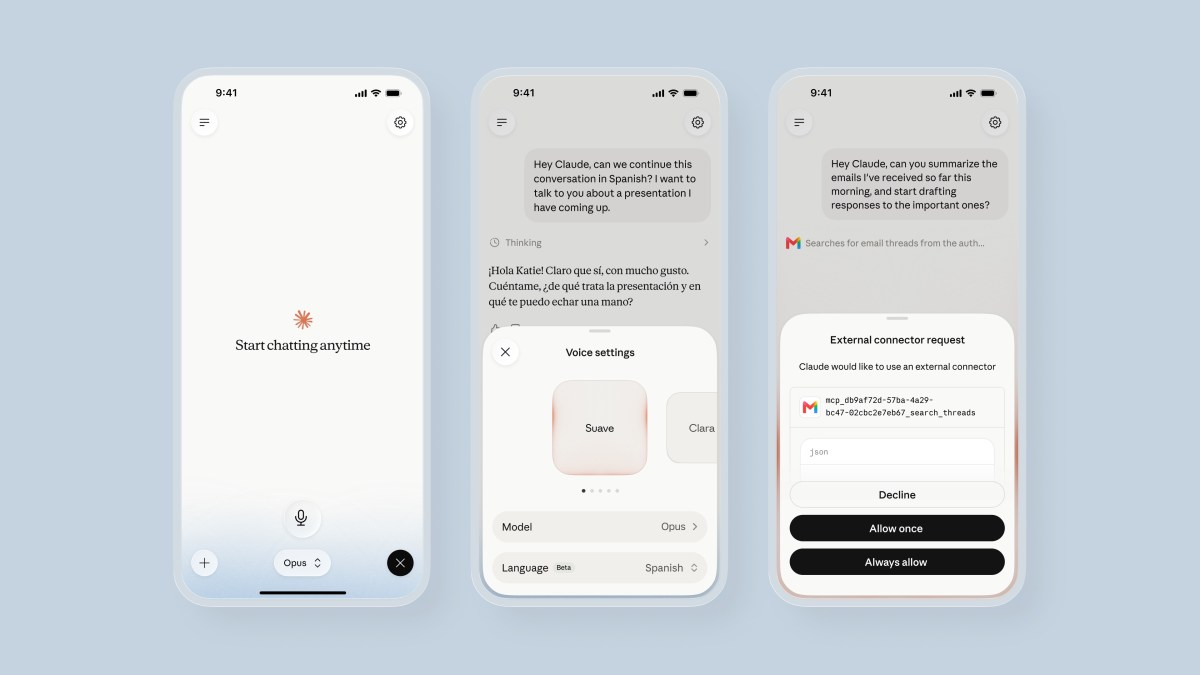
Anthropic's Claude voice mode update on July 23, 2026 is the reason "anthropic claude voice mode update" spiked about 1,400% in US rising searches over the past four hours. Voice mode is no longer stuck on Haiku alone. Paid users can now route spoken sessions through Sonnet or Opus, keep the last text-chat model as the default, and switch models mid-conversation while Claude still uses the fastest variant of the selected tier so the talk stays fluid.
That is a real product change for people who already use Claude for coding, product work, and client pitches. Until today, the model picker in voice looked more powerful than the session behind it. Haiku was fine for quick answers and terrible for multi-step thinking. The update closes that gap and, importantly for builders, pairs stronger models with app connectors such as Gmail, Google Calendar, Slack, Canva, and Notion.
This guide covers what shipped, who gets which capabilities, how Claude voice now compares with ChatGPT voice, and how coding teams should actually use spoken agents without turning their repo into a messy dictation transcript. Related reading controlled harnesses, what coding agents still fail at, and our vibe coding definition.
US rising searches (past ~4 hours) tied to this story
Relative increase percentages from US rising-search exports on July 23, 2026 (16 to 03–20 to 04 window). Values are normalized for chart readability, the voice-mode query led by a wide margin.
What Anthropic actually shipped today
TechCrunch, 9to5Mac, and Engadget all report the same core change. Claude voice mode can now use Opus, Sonnet, and Haiku. Previously, voice conversations were powered by Haiku even when the UI suggested otherwise. Anthropic says voice mode now picks the last model you used in text chat and uses the fastest version of that model by default so latency does not explode when you move up the tier ladder.
The company frames the update around longer, higher-stakes conversations, feedback on communication style, rehearsing a client pitch, and brainstorming product or market research. Those are not coding-only jobs, but they matter to product engineers who spend half their day in meetings and half their day in a terminal.
Connectors are the second half of the story. Claude voice can now act through connected apps when you grant permission. Reported examples include rescheduling a meeting, drafting email, and creating a Notion document. That is a meaningful difference from OpenAI's recent voice refresh, which improved conversational feel but still limited tool use in the live voice path.
Claude voice mode at a glance (July 23, 2026)
| Value | Detail |
|---|---|
| Opus/Sonnet/Haiku | Model choices in voice |
| 11 languages | Spoken language support |
| All platforms | Web, desktop, mobile beta |
| Haiku + 1 app | Free-tier ceiling |
Compiled from Anthropic's July 23, 2026 coverage. Confirm live plan limits in your account before you promise a workflow to a team.
Language support and free-tier limits
Anthropic lists English, French, German, Hindi, Indonesian, Italian, Japanese, Korean, Portuguese (Brazilian), and Spanish for Latin America and Spain. Users can switch languages, but they may need to specify the language rather than relying on perfect auto-detection. Multilingual voice left beta earlier in 2026, today's story is model quality, not the first day of speech support.
Free users stay on Haiku and can connect only one app. Paid users unlock the higher models and broader connector use. That split is important for team policy. If your organization standardizes on free Claude seats for interns, do not design a voice-driven ops workflow that silently depends on Opus.
Plan expectations for Claude voice mode after the July 23 update
| Seat type | Models in voice | Connectors | Best use |
|---|---|---|---|
| Free | Haiku only | One connected app | Quick Q&A, light dictation |
| Paid individual | Haiku, Sonnet, Opus | Multi-app connectors | Pitch practice, research, drafting |
| Team / Enterprise | Same model ladder + admin policy | Org-approved connectors | Shared workflows with audit needs |
Why this spike is about Anthropic, not only voice
The same four-hour window also lit up anthropic hq, anthropic jobs, anthropic careers, what does anthropic mean, anthropic pbc, and IPO/stock questions. Voice mode is the fresh product hook. The surrounding queries show broader curiosity about who Anthropic is, how it is structured as a public benefit corporation, and whether people should work there or invest when a listing eventually appears.
For SEO and editorial planning, that means a pure feature note is not enough. Readers landing from "what does anthropic mean" need a plain definition, and readers landing from "claude voice mode" need setup steps. Both groups benefit from a calm comparison against ChatGPT voice rather than a fan post.
Claude voice vs ChatGPT voice for people who ship software
OpenAI refreshed ChatGPT voice earlier in July with more natural conversation models. Anthropic's answer is capability depth, stronger models plus tool hooks. If your primary need is a human-sounding back-and-forth while you drive or walk, either product can work. If your primary need is "talk me through the architecture, then put the action items into Notion and Slack," Claude's connector path is currently the more interesting option based on public reporting.
Neither voice mode replaces a coding harness. Spoken sessions are great for requirements capture, rubber-ducking a design, and narrating a demo script. They are a weak place to paste secrets, approve production deploys, or apply multi-file refactors without review. Treat voice as an intake and thinking surface. Treat your editor agent, tests, and CI as the delivery surface.
Voice mode decision matrix for developers
| Job | Prefer Claude voice after this update | Prefer ChatGPT voice | Prefer text agent instead |
|---|---|---|---|
| Brainstorm a product pitch | Yes — connectors + stronger models | Yes if you already live in ChatGPT | Only if you need long citations |
| Debug a failing test suite | Maybe for talking through hypotheses | Maybe | Yes — keep diffs and logs in text |
| Draft release notes while walking | Yes | Yes | No need |
| Touch production infrastructure | No | No | Yes with human approval gates |
A practical developer workflow for voice
- Start in text with the model you want. Voice will inherit that choice.
- Connect only the apps you actually need. Gmail plus Calendar is usually enough before Slack.
- Use voice to capture requirements, goals, constraints, non-goals, and acceptance checks.
- Ask Claude to restate the plan as a numbered checklist you can paste into an issue tracker.
- Switch back to a coding harness or Claude Code / editor agent for implementation.
- Return to voice only for review of the human summary, not for silent production changes.
If you try to do everything in one continuous spoken session, you will lose structure. Voice is continuous. Software delivery is discrete. The bridge is a written artifact, an issue, a design note, a failing test, or a pull request description. Without that bridge, you get a good conversation and a bad audit trail.
Security and privacy notes teams should not skip
Connectors turn a chat product into a lightweight agent. That means credential scope, retention, and human confirmation matter. Do not connect a personal Gmail full of customer PII to a shared demo account. Do not let voice-created calendar invites become the only source of truth for launch windows. Do not paste API keys into a spoken session because you are lazy about a password manager.
Enterprise teams should treat voice connectors like any other OAuth integration, least privilege, named owners, revocation runbooks, and a clear rule that voice never has write access to production systems. If Anthropic later expands tool use further, those policies will already exist instead of being invented during an incident.
How to evaluate the update without the demo trance
Run three private tasks before you change team defaults. First, a 10-minute product brainstorm with a connector write into Notion. Second, a bilingual handoff if your team ships internationally. Third, a hard technical explanation, ask voice to walk through a failing CI log and propose a fix plan, then compare the plan against what a text Sonnet or Opus session produces with the same log attached.
Score latency, factual precision, connector reliability, and whether the session ends with a reusable artifact. If voice is only slightly worse than text on hard tasks but much better for capture while mobile, keep it as an intake tool. If it invents confident nonsense under pressure, keep Haiku for chatty work and reserve paid models for text where you can inspect tokens more carefully.
What this means for The Vibe Father stack
A multi-model coding harness still wins when the job is code. Voice upgrades do not change the need for pin-able model revisions, private evals, and review gates. What they change is the front door. More product work will start as speech. More meeting follow-ups will be AI-drafted. More requirements will arrive half-structured from a walk around the block.
Your harness should accept that input cleanly, paste the voice transcript or checklist into a planning agent, force a written plan, then implement with a coding model under tests. If your stack cannot accept messy human speech as input and still produce a disciplined patch, you will feel today's product news as chaos instead of leverage.
Common questions
Is Claude voice mode free?
Yes at a limited level. Free users can use voice on Haiku with one connected app. Opus and Sonnet voice routing require a paid seat according to July 23, 2026 reporting.
Does Claude voice now use Opus and Sonnet?
Yes. That is the headline change. Voice mode can use Opus, Sonnet, or Haiku, defaults to the last text model, and uses the fastest version of the selected model for smoother conversation.
Can Claude voice edit my calendar or email?
With connectors enabled, Claude can help with tasks such as updating meeting times and drafting email through connected apps. Grant only the permissions you need and review writes before you trust the habit.
Should coding teams replace chat agents with voice?
No. Use voice for capture and thinking, then implement in a text or IDE agent with tests and review. Spoken sessions are a weak system of record for production changes.
Sources and further reading
- TechCrunch. Anthropic updates Claude voice mode
- 9to5Mac. Claude voice mode Opus and Sonnet
- Engadget. Claude voice mode just got smarter
- Controlled harness guide on this site
- What is vibe coding
A practical way to keep this advice alive is to write a one-page operating note after you read a news cycle. Name the default tool for each lane, the fallback path, the private tasks that decide upgrades, and the person who can change the pin. When the next launch post arrives, open that note before you open the settings panel. Most thrash comes from changing defaults in the same hour emotions peak.
Share the note in the engineering channel and invite disagreement with evidence. If someone believes a new product or model is better, they should run the suite and paste the score delta, the cost delta, and one trajectory that shows why. Social proof is not a substitute for that packet. The packet also protects quieter teammates who do not enjoy arguing in public but do notice quality changes in review.
Keep a short failure diary for AI-assisted work. When a patch looks fluent and still breaks production assumptions, write three sentences, what the agent assumed, what the system actually required, and what check would have caught it. Over a month those sentences become better prompts, better tests, and better training for humans. They also become the opposite of hype, durable institutional memory.
Budget attention the way you budget tokens. Not every article, model card, or executive quote deserves a process change. Create a weekly thirty-minute review where platform owners scan only the changes that touch your default stack. Everything else can wait. This is how you stay informed without becoming a full-time launch spectator.
Finally, keep the human center of the work visible. Tools change weekly. People still carry pager pain, customer trust, and the craft of clear design. If your AI program makes those people faster at responsible work, it is succeeding. If it only increases the volume of plausible text that others must clean up, it is a costume. Measure which one you are funding and adjust without drama.
When leadership asks for a simple story, give a simple true story. We route by task. We pin revisions. We measure accepted work and repair time. We keep a backup path. We do not bet the company on a single delayed SKU or a single generous context window. That story is calm enough for a board slide and strong enough for a Monday standup.
If you manage a mixed-seniority team, pair AI rollout with explicit mentorship time. Juniors can learn quickly with agents, and they can also learn brittle habits quickly. Require them to explain why a patch is safe before merge. Require seniors to review the risky surfaces even when the diff looks tidy. The combination builds judgment instead of dependence.